
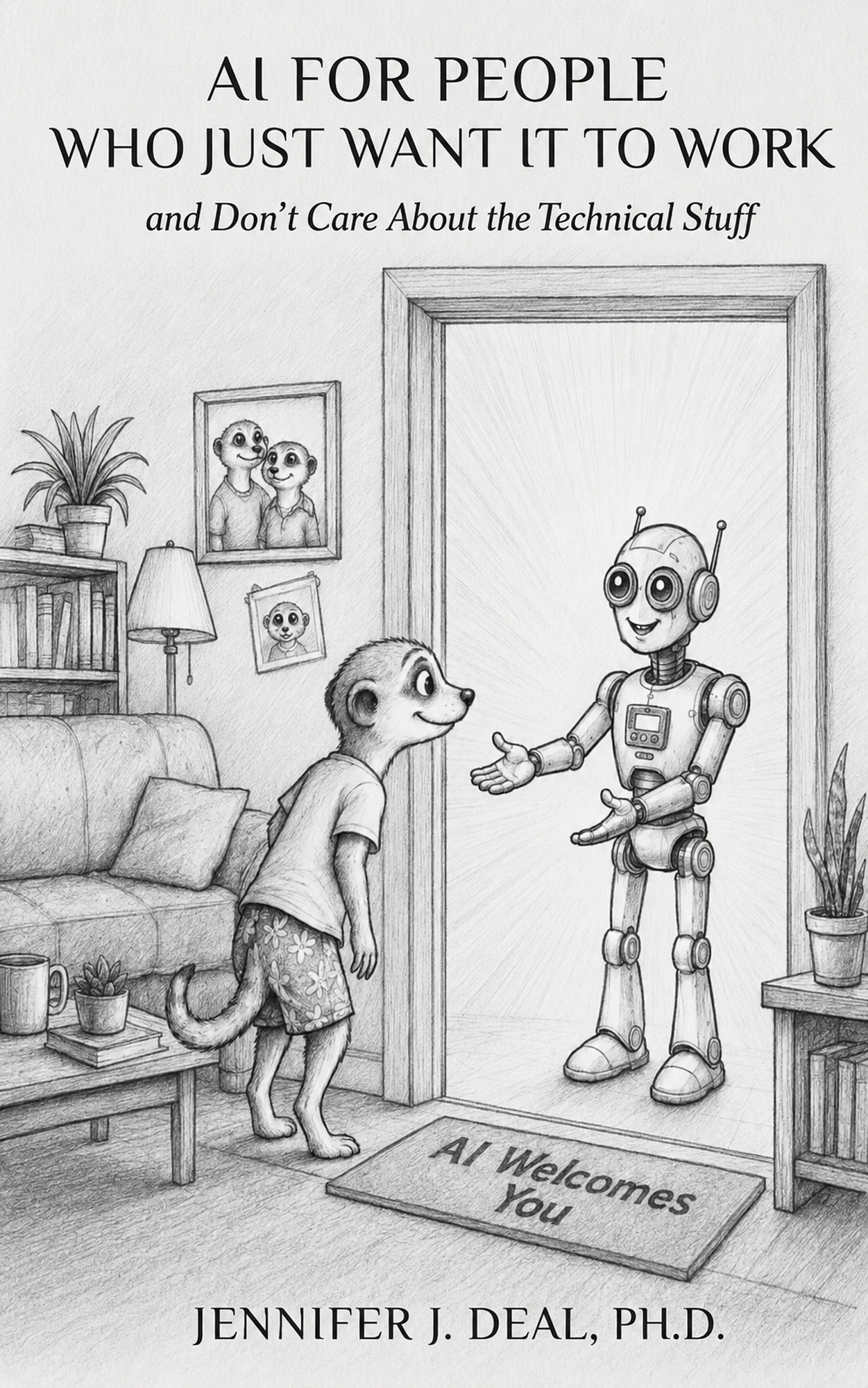
AI for People Who Just Want It to Work and Don’t Care About the Technical Stuff
If you can type a message, you can use AI. There’s nothing to install and nothing to break, and you don’t have to like the idea of AI to get something out of it. Used carefully, on your own terms, it turns out to be a surprisingly good way to get help with something or learn anything you’ve ever wanted to learn. Ask it to plan a trip, explain a contract or what bug is causing your roses to wilt, teach you poker, or draft the email you’ve been avoiding for a week. Then ask it something else. It’s hard to stop!
This book is for beginners and for people who’ve tried ChatGPT, Claude, Gemini, or Copilot, and weren’t sure what to do next. If it feels like you don’t know what to do with it, that goes away fast once you start using it for something you’re interested in. This book shows you how to do that well. You’ll learn how to get useful work out of it (including a trick that gets the AI to write the prompt for you), how to tell when what comes back is wrong or generic, and how to decide which jobs to hand over and which to keep. Everything in this book can be used the same day you read it, with the tools you already have, and the work already on your desk. No theory, no jargon, and cartoons throughout.
Part One covers the basics: which tools to use, where your work goes when you type it in, why AI sounds so confident when it’s totally wrong, and why small errors compound into big ones when you hand it larger jobs. Part Two shows you how to set up a workspace that remembers your files and instructions in ChatGPT, Claude, Gemini, and Copilot, with step-by-step screenshots and a worked example of an agent that finds sales leads in your inbox. Part Three is a set of short exercises that help you learn how to be an effective user of AI.
Click to purchase from Amazon.
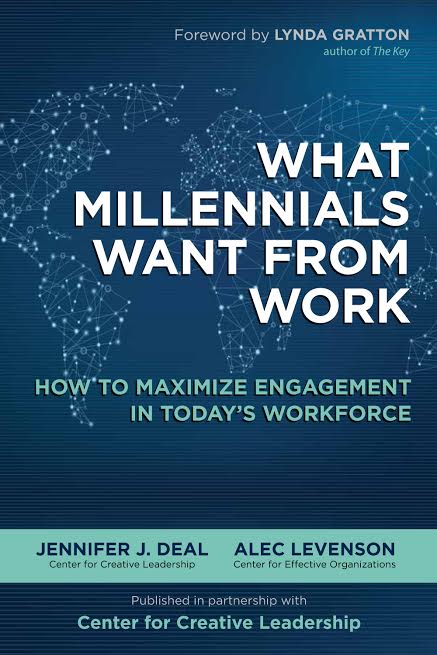
Millennials are the future of your business. How can managers and leaders of organizations better engage them to gain a competitive advantage?
Millennials have been burdened with a reputation as spoiled, lazy, and entitled, but the reality behind the stereotype is far richer and more complex. Who are Millennials and what do they really want?
This essential book explains who Millennials really are, and offers practical advice to help those who manage, lead, and work with Millennials to improve teamwork, increase productivity, strengthen organizational culture, and build a robust talent pipeline.
Based on fieldwork and survey data from global research on more than 25,000 Millennials and 29,000 older workers in 22 countries, this book paints a comprehensive, scientifically accurate picture of what really motivates Millennials around the world.
Learn how to get the most from Millennials by:
- Improving workplace flexibility—because Millennials don’t separate life and work
- Providing adequate support and feedback—because Millennials like to learn and grow
- Coaching, not micromanaging—because Millennials value autonomy
- Designing competitive salary structures—because Millennials know what’s up
- Providing opportunities to contribute to society—because Millennials care about doing good
Fundamentally, Millennials want a satisfying job that pays well, coworkers they like and trust, advancement opportunities, and the occasional pat on the back. Who doesn’t want those things?
What Millennials Want from Work is the most comprehensive, in-depth look at this generation to date―indispensable for managers, HR professionals, and global business leaders seeking to align long-term organizational goals with the realities of the new workforce.
Click to purchase from Amazon.
Retiring the Generation Gap: How Employees Young and Old Can Find Common Ground
How different are the generations, really? Everybody knows that the “generation gap” between younger and older people causes stress and frustration at work. Are the differences people complain about just a big misunderstanding, or are they real? And most important, how can you use similarities and differences among the generations to be more effective in your organization? Jennifer Deal explains what can be done to retire the generation gap. Written in a highly accessible (and often witty) style, this groundbreaking book addresses a number of generational issues. Deal provides a description of each issue, a summary of the relevant research results, a principle that can be applied to resolve (or at least mitigate) the issue, and practical advice for applying the principle in the workplace. Applying these principles will help everyone to work with, work for, attract, manage, retain, and develop leaders of all generations.
Click to purchase from Amazon.
ISBN-13: 978-0787985257
Success for the New Global Manager
How can you understand this role and develop either yourself or others to be successful in it? This book, based on a study of more than two hundred managers in thirty countries, first describes this new breed of global manager and then introduces a set of pivotal skills — international business knowledge, cultural adaptability, perspective-taking, and having skill as an innovator — that are essential for becoming a successful global leader.
Click to purchase from Amazon.
ISBN-13: 978-0787958459
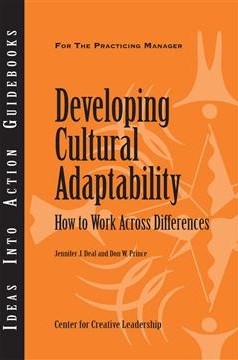
Developing Cultural Adaptability: How to Work Across Differences
Effectively managing cultural differences isn’t just an intellectual exercise, it is critical competency for anyone working on today’s world. For managers working in an increasingly global environment it’s a pivotal skill for success. This book will help you learn how to expand your and others’ cultural adaptability.
Click to purchase from Amazon.
ISBN-13: 978-1882197804